


I still did not do genealogy research; I was only interested in the old Finn Peder Pedersson Ossmi that should have arrived in Sweden in the early 1600's. Anbytarforum gave me interesting tidbits on a Per Osmi who by Royal letters from Karl IX had been allowed to be the first settler to reside in Hörken in Ljusnarsberg. But, still, I did not know if this Per Osmi was an ancestor to my Erik Matsson. I had learned from my reading of the contributions on Anbytarforum that such assumptions could not be made easily, solely based on an old hand written manuscript from the early 1900s.
How I then jugglery with different keywords on Google is impossible to remember in detail, but suddenly it was there. A family tree of a certain Per Persson Osmi. It was compiled by the editor of the web newsletter - GLIMTEN - as a birthday present to the family Roggentin. Here, I could follow the Osmi family to the present days. In this family tree was also an Erik Matsson born in 1774 in Hörken in Ljusnarsberg son of the mine owner (Bergsman) Mats Henriksson Osmi. According to my hand written source Erik Matsson got his first child in 1799 so, so far, it seems consistent. The problem was that I could not be absolutely sure that this was the same Erik Matsson because there was no date of birth for him in my hand -written tree.
I knew, however, whom he was married to and that he had at least 12 children.
I called Mr. Bertil Magnusson - the author of Roggentin's family tree. That was how I got my first lesson in genealogy. During nearly two hours at his home, we turned and twisted the problem and concluded that it most likely was the same Erik Matsson we talked about but not with absolute certainty.
The crucial evidence, I found again on Anbytarforum by searching for the farm Stråtgården on Google. Under the category Ljusnarsbergs, Mr. Harald Stråth had written about his family farm's (Bergsmansgård) history.
 He writes: ".....The Bergsman [1] and Sexman [2] Erik Mattsson, born in 1774 in Södra Hörken, became the new owner on the farm. He married in 1803 with Christina (Stina) Hansdotter from Kyrkbacken. They had 13 children together. The wife died in 1839. Erik Mattsson married at 77 years of age with Elisabeth Catharina Hammar born in 1774 in Linde. Erik Mattsson died in 1844 and wife No. 2 moved back to Linde."[3]
Voila! Here, we apparently talk about the same person since the year 1774 is the same as that of the descendant of Per Osmi and
all other data including the wife's name, are consistent with my relative. I have looked up some other details and found that some information both in Roggentin's Pedigree and Harald Stråth's information on my ancestor is not completely accurate, but nothing that alters the fact that we are talking about the same person. This taught me to be critical in the sense that many genealogists have better accuracy of their data, the more central a person is for their own family. Peripheral persons are for natural reasons not worth that much double checking. As Erik Matsson was central to my research, I have later - when I started with genealogy - checked him extra carefully in church records and found, for example, that he is not born in 1774-03-05 but 1774-05-15. Probably the first date comes from a PARISH CATECHETICAL MEETING (Husförhör) minutes of Mats Henriksson's family. The priest's handwriting can sometimes be difficult to interpret.
I checked the birth records which are probably the nearest the truth as one can get because it is written in connection with the birth. I have also checked the data on Osmi in Ljusnarsberg's Chronicle from the 17th century during a visit in Kopparberg. I have now taken the habit of always looking in the year after and before the alleged birth if I do not find a person directly in
the birth record. It has often produced results.
 A fun event was much later when I searched for my grandfather's mother Sofia Mose. She would, according to the CD Sveriges Dödbok 1947-2003 be born in 1873 in Färnebo, Värmland. The same information I had received from relatives who remember her.
There was however no Sofia Mose born in Färnebo 1873 - however, an Amanda Moses was born November 4 that year and in the PARISH CATECHETICAL MEETING RECORDS 1874 a younger sister Sofia was born June 12. Sadly enough the mother died in 1880 and the father Nils Johan Mose was alone with four young children. Apparently, this became too much for him and he emigrated to America in 1882 and left the children remain in Sweden to be taken care of by the "social authorities" or "he escaped to America" as the church record says.
If one follows Sofia Moses in PARISH CATECHETICAL MEETING RECORDS, one can see that she in 1888, only 14 years of age, moved from Pärlby to Björnhyttan in Norrbärke parish to work as a maid. Exit records from Färnebo parish has the correct birth time, but in the entry records to Norrbärke, she has become half a year older and thus 15 years in a couple weeks. Could she have been so enterprising that she stated the wrong date of birth at the new place to hide her low age or was it again i sloppy priest who was to blame? She however carried with her the new birth date all her life. Certainly, it is exciting to try to understand her situation?
This was a story that came much later and at the time of my studies of the family Osmi, I had never seen a PARISH CATECHETICAL MEETING RECORD. Nor had I any way to document my discoveries. But I was of course not a genealogists at the time!
[1] A Bergsman was a person who owned a mine. He was also farmer and a forester. The mining was however his main profession, the timber was for the production of iron and the farm for providing food for his family and employee. The home of a Bergsman was called Bergsmansgård and were often quite impressing buildings build in timber. Quite a few of them are still around.
[2] A Sexman was one of six elected and highly trusted Bergsmen who had the duty to control that all legal and economic regulations were met by the other Bergsmen in the community.
[3] Linde is nowadays formally called Lindesberg, but still, Linde is used by people who live there.
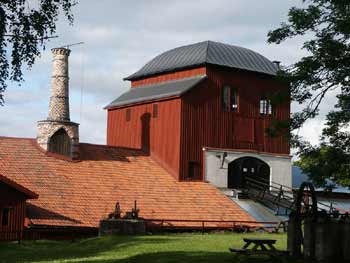
Pictures: First picture shows Pershyttan Bergsmansgård outside Nora, second picture shows the old blast furnace at Pershyttan. The third picture shows Sofia Mose.
/This text was first published in January 2007/


