There was also a Johanna Catharina Klingert. I later discovered that it is fortunate to have some unusual names in the family because it is much easier for a beginner to follow such families in the parish registers [1]. Apparently my half-aunt had help from more experienced family history researchers because there was a stack of papers with data from Kajsa Östberg who researched the family Hägerman. Johanna Catharina's mother was of Hägerman family. Now, I had quite a lot of material but no good way to structure it. I had read that there was something called pedigree chart and I also understood that a good spiral block is the cornerstone of genealogy research. My problem was however that I had never throughout my entire university studies taken any notes other than names and phone numbers despite I had attended hundreds of lectures, so spiral block and handwritten pedigree charts did not attract me very much. The computer has been my dearest gear since 1980, so I started looking for genealogy program for my computer. You now begin to realize how ignorant I was - right?
As everyone knows, there are a numbers of good programs around. I found the Swedish off-line programs Holger and MinSläkt first. I tried them and they both seemed fantastic, but I settled for MinSläkt mostly because of the very attractive interface. It looked exactly as I had imagined a genealogy program should look - all persons in clear boxes with clear relationships. The graphics on the screen made me understand what it was about. Awesome!
You might understand that I quickly began to enter all of my information from various sources. To remember to note down all sources for the data was no problem, it's an occupational disease with me, old university researcher as I am. However, I would like to stress the importance of this as there may be errors in the data even from the most experienced genealogists. It is therefore good to be able to see directly in a record if it is based on an original source or if it is secondary data from other researchers. If you do so you can later go back and check if, for example, a birth record is correct
It was fortunate that I had my solid habits for at that time I had not seen a single church record. However, I had many times seen strange references like “Norrbärke, C :7, 1837-1856 , 0/ 0, p169” when I surfed around on e.g. Anbytarforum [2] (this is a reference to a birth record in Norrbärke parish for the above mentioned Johanna Catharina Klingert as it is registered in Genline). The way I imagined a church record at the time was an old dusty book available in the church and I imagined how difficult it would be to travel to Norrbärke church in Dalarna to read it. Fortunately my Googling led me to Genline [3] and then the last resistance against family history research disappeared. I could not have imagined that one could sit at the kitchen table and flip through all the Swedish church records. One could click around between the parishes as if one traveled in a time machine with the speed of light. This was very different to old days when one had to throw oneself on the bike and pedaling off to the neighboring parish! At the same time said the old Lutheran in me: "This is not a sport anymore. It is too easy!"
Happily enough my even stronger intrinsic convenience took over and I enjoyed reading about the crofter with 12 children, half of which died young and several ended up in the poor-house when their father got a tree over him in the woods and died. Sure one becomes a little bizarre of this?
Nothing could stop me now. An annual subscription to Genline was purchased and a membership in DIS – Datorstöd i Släktforskningen - and another membership in Sveriges Släktforskarförbund. I've always been like that! Should I do something it should be done properly!
EXPLANATIONS
1. PATRONYMIC: The normal way of naming people before mid-1800s was a system called patronymics. It means that the children got their last names after their father’s first name. If the father’s name was Erik all the daughters got the name Eriksdotter or sometimes Ersdotter and the sons got the names Eriksson or Ersson. This just means the daughter or son of Erik. Note that it is always spelled with two “s” in Sweden, which mostly were dropped when such a person came to USA. You find the same naming system in many European countries, like Ireland (O’), England (-son) or Scotland (Mac). In mid-1800s the patronymics was gradually changed into surnames (often the last patronymic) and in 1909 it was forbidden to use patronymics as all people in the same family had to have the same surname. This rule has gradually became more liberal and now it is quite free to adopt surname of you taste as long as they are not taken by noble families or in any way offensive.
NOBLE FAMILIES used their surnames in combination with patronymics. The first protestant king Gustav I Vasa’s full name Gustav Eriksson Vasa.
 PRIESTS mostly adopted Latin patronymics in combination with their Swedish patronymics. One example is the son of the tailor Anders Persson, who’s Swedish patronymic was Lars Andersson. Translated into Latin it became Laurentius Andreae. When a priest got his parish it was a custom to add a name that told where he was born. As he was born in the parish of Kopparberg in the village Falan, he took the name Cuprimontanus, which was the Latin translation of the parish name Kopparberget (Copper Mountain). He, however, later changed his name to Phalander, which was the Latin version of the village Falan. Interesting enough it was a custom to address priests simply by first name so he was Herr Lars (Mr. Lars) in all official documents and situations.
SOLDIERS were given soldiers names, but were also recognized by their patronymics. Soldier’s names “belonged to” the village and were “inherited” from soldier to soldier even if they were not related.
PROFESSIONALS and PEOPLE IN CITIES often changed into surnames, marking their profession or some skills or something significant or the place of birth. Patronymics were however always more or less present as a link to ancestors and a sure way to distinguish people from each other in small communities.
2. Anbytarforum is a very professional forum for Family history research in Sweden. It is strictly divided into themes and you can present your problems in English and get the answers in the same language.
1945.
3. Genline is a searchable collection of images in black and white of all Swedish church records. They are photographed from the films that were taken by the Mormons for their own use. A copy of these films were donated to the Swedish archives and later published on the Internet and made available to public for a fee. If you however have ancestors in Norway their church record are available on the Internet for free. Genline was later bought by Ancestry and are now available for their members.
The Swedish church records are also available on The Internet from SVAR for a fee. The third service who offer church records is ArkivDigital who has taken new photos in high resolution color of all original church records and much more. This service is also available for a fee and holds a very high quality.
One must note that the reference addresses to individual pages in the records differ between Genline and the other two services which are consistent with the original books in the archives as Genline refers to the films taken by the Mormons.
You might understand that I quickly began to enter all of my information from various sources. To remember to note down all sources for the data was no problem, it's an occupational disease with me, old university researcher as I am. However, I would like to stress the importance of this as there may be errors in the data even from the most experienced genealogists. It is therefore good to be able to see directly in a record if it is based on an original source or if it is secondary data from other researchers. If you do so you can later go back and check if, for example, a birth record is correct
It was fortunate that I had my solid habits for at that time I had not seen a single church record. However, I had many times seen strange references like “Norrbärke, C :7, 1837-1856 , 0/ 0, p169” when I surfed around on e.g. Anbytarforum [2] (this is a reference to a birth record in Norrbärke parish for the above mentioned Johanna Catharina Klingert as it is registered in Genline). The way I imagined a church record at the time was an old dusty book available in the church and I imagined how difficult it would be to travel to Norrbärke church in Dalarna to read it. Fortunately my Googling led me to Genline [3] and then the last resistance against family history research disappeared. I could not have imagined that one could sit at the kitchen table and flip through all the Swedish church records. One could click around between the parishes as if one traveled in a time machine with the speed of light. This was very different to old days when one had to throw oneself on the bike and pedaling off to the neighboring parish! At the same time said the old Lutheran in me: "This is not a sport anymore. It is too easy!"
Happily enough my even stronger intrinsic convenience took over and I enjoyed reading about the crofter with 12 children, half of which died young and several ended up in the poor-house when their father got a tree over him in the woods and died. Sure one becomes a little bizarre of this?
Nothing could stop me now. An annual subscription to Genline was purchased and a membership in DIS – Datorstöd i Släktforskningen - and another membership in Sveriges Släktforskarförbund. I've always been like that! Should I do something it should be done properly!
EXPLANATIONS
1. PATRONYMIC: The normal way of naming people before mid-1800s was a system called patronymics. It means that the children got their last names after their father’s first name. If the father’s name was Erik all the daughters got the name Eriksdotter or sometimes Ersdotter and the sons got the names Eriksson or Ersson. This just means the daughter or son of Erik. Note that it is always spelled with two “s” in Sweden, which mostly were dropped when such a person came to USA. You find the same naming system in many European countries, like Ireland (O’), England (-son) or Scotland (Mac). In mid-1800s the patronymics was gradually changed into surnames (often the last patronymic) and in 1909 it was forbidden to use patronymics as all people in the same family had to have the same surname. This rule has gradually became more liberal and now it is quite free to adopt surname of you taste as long as they are not taken by noble families or in any way offensive.
NOBLE FAMILIES used their surnames in combination with patronymics. The first protestant king Gustav I Vasa’s full name Gustav Eriksson Vasa.
PRIESTS mostly adopted Latin patronymics in combination with their Swedish patronymics. One example is the son of the tailor Anders Persson, who’s Swedish patronymic was Lars Andersson. Translated into Latin it became Laurentius Andreae. When a priest got his parish it was a custom to add a name that told where he was born. As he was born in the parish of Kopparberg in the village Falan, he took the name Cuprimontanus, which was the Latin translation of the parish name Kopparberget (Copper Mountain). He, however, later changed his name to Phalander, which was the Latin version of the village Falan. Interesting enough it was a custom to address priests simply by first name so he was Herr Lars (Mr. Lars) in all official documents and situations.SOLDIERS were given soldiers names, but were also recognized by their patronymics. Soldier’s names “belonged to” the village and were “inherited” from soldier to soldier even if they were not related.
PROFESSIONALS and PEOPLE IN CITIES often changed into surnames, marking their profession or some skills or something significant or the place of birth. Patronymics were however always more or less present as a link to ancestors and a sure way to distinguish people from each other in small communities.
2. Anbytarforum is a very professional forum for Family history research in Sweden. It is strictly divided into themes and you can present your problems in English and get the answers in the same language.
1945.
3. Genline is a searchable collection of images in black and white of all Swedish church records. They are photographed from the films that were taken by the Mormons for their own use. A copy of these films were donated to the Swedish archives and later published on the Internet and made available to public for a fee. If you however have ancestors in Norway their church record are available on the Internet for free. Genline was later bought by Ancestry and are now available for their members.
The Swedish church records are also available on The Internet from SVAR for a fee. The third service who offer church records is ArkivDigital who has taken new photos in high resolution color of all original church records and much more. This service is also available for a fee and holds a very high quality.
One must note that the reference addresses to individual pages in the records differ between Genline and the other two services which are consistent with the original books in the archives as Genline refers to the films taken by the Mormons.
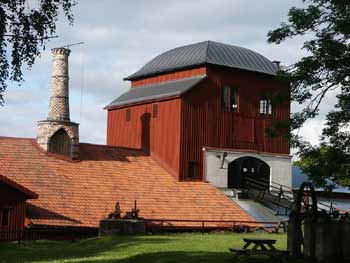
Building above is a bergsmansgård that was build by one of my ancestors Lars Hansson in the 1700s. It is now a part of the open-air museum in Smedjebacken where it was moved in 1945.
Seal above belonged to Laurentius Andreae Phalander